Pay Monthly Websites UK (2026): How They Work, What They Cost and the Catches

By Nick Croce
A pay monthly website is exactly what it sounds like: instead of paying a designer a few thousand pounds up front, you pay a monthly fee and get a website, with the hosting and some level of looking-after bundled in. For a lot of small businesses it’s the only way a professional site is affordable in year one, which is why so many agencies now offer it.
I offer one too, so I’m not neutral. But the model has a mixed reputation for a reason: the horror stories are always the same, a business owner who signed up for £40 a month and found out two years later that they didn’t own the site, couldn’t move it and were still paying. This article is the version I’d want a friend to read before signing anything, including with me.
How pay monthly websites work
There are really two models hiding behind the same phrase, and the difference matters more than the price.
Spread the cost. The designer builds the site and you pay for it in instalments, typically over 12 months. At the end, the site is paid for and it’s yours. The monthly fee is a payment plan, not a subscription, and hosting is usually a separate, smaller cost afterwards.
Subscription. You pay every month for as long as you want the site to exist. The fee covers the build, hosting, security and usually a set amount of updates. Stop paying and the site goes offline. This is the more common model, and it’s the one with the catches, because the site is the provider’s asset, not yours.
Neither is wrong. A subscription can be excellent value if the provider genuinely looks after the site every month. It’s a bad deal when the fee buys hosting and nothing else, and you only find that out when you ask for a change.
What pay monthly websites cost in the UK
Prices vary a lot, so here are the bands you’ll see, plus what the alternatives cost, so you can compare like with like. The monthly figures for the first three rows are from a look across UK providers’ published prices and price guides at the time of writing; the Squarespace and Managed-For-You figures are current list prices.
| Route | Typical monthly cost | Contract | Who owns the site |
|---|---|---|---|
| Pay monthly provider, entry level | £29 to £50 a month | 12 to 36 months | Usually the provider |
| Pay monthly provider, updates included | £50 to £115 a month | 12 to 36 months | Usually the provider |
| Agency-run plan, design and updates included | £115 to £250 a month | 12 to 36 months | Usually the provider |
| Build it yourself on Squarespace | £12 to £29 a month, plus your time | Monthly or annual | You |
| Custom Squarespace build, paid once | From £3,000 once, then £12 to £29 a month paid to Squarespace for hosting | None | You |
| Managed-For-You with me | From £150 a month, build included | One year minimum, billed annually | You. If you leave, I hand you the full code |
The number that matters is the three-year total, because that’s roughly how long a small business site lasts before it needs a rethink. A £49-a-month subscription is £1,764 over three years, which is cheaper than a custom build, as long as the site is actually good and actually looked after. A £115-a-month one is £4,140, which is more than a custom build you’d own outright, and a £250-a-month agency plan is £9,000. At that point you’re paying for the service, so the service had better be real.
The catches to check before you sign
None of these are illegal or even unusual. They’re just the things that turn a sensible monthly fee into a trap if you don’t know they’re there.
- You don’t own the site. On most subscriptions the design, the code and sometimes even the content belong to the provider. If you leave, you start from a blank page. Ask in writing: if I cancel, what do I get to keep?
- The minimum term. Twelve months is normal. Twenty-four or thirty-six is a lot of commitment to a site you haven’t seen yet. Check what happens if the business changes or closes before the term ends.
- Automatic renewal. Some contracts roll straight into another fixed term unless you cancel in a narrow window. Find the notice period and put it in your calendar.
- What “updates included” means. One text change a month? Two hours? Anything you like? And how fast? A plan that includes updates but takes three weeks to make one isn’t really including them.
- The domain. Make sure your domain name is registered in your name, not the provider’s. If they hold it, they hold your business’s address on the internet.
- Templates sold as design. At the cheaper end the site is a template with your logo and colours dropped in. That can be fine. It isn’t fine if you were told it was bespoke.
- Exit fees and “buy-out” prices. Some providers will sell you the site if you want to leave. Ask what that number is before you sign, not after.
Seven questions to ask any pay monthly provider
- If I cancel after the minimum term, what do I keep: the domain, the content, the design, the site itself?
- What exactly is included each month, and how quickly are changes made?
- What platform is the site built on, and could another designer take it over?
- Is hosting, SSL and the domain renewal included, or billed separately?
- What happens to the price after the first term?
- Can I see three sites you built on this plan, and speak to one of the owners?
- Who is doing the work, and will I deal with them directly?
A good provider will have answers ready and won’t mind you asking. If any of them get vague on question one, that tells you what you need to know.
Who pay monthly websites suit, and who they don’t
They suit you if you’re starting out or cash is tight, you want one predictable bill, you don’t want to learn a website editor, and you’d rather someone else dealt with hosting, security and updates for good. Trades, clinics, consultants, cafés and small professional firms are the classic fit: the site needs to look right, say the right things and be easy to change, and nobody in the business wants to run it.
They don’t suit you if the website is the business: an online shop with hundreds of products, a membership site, anything with complex features. In that case you want to own the asset outright, and a one-off build is the better route. They’re also the wrong choice if you enjoy tinkering with your own site, because you’ll resent paying someone else to do it.
The DIY alternative: Squarespace
The honest comparison for a pay monthly website isn’t a £3,000 custom build. It’s Squarespace. For £12 to £29 a month you get hosting, security, templates and an editor that doesn’t break, and you own the result. If you have a few evenings and an eye for layout, you can get a respectable site live yourself.
What you don’t get is the design, the words, the structure and the setup, which is where most DIY sites fall down, and it’s why I build custom Squarespace sites for people who want to own and run their own. I’ve put the two platforms head to head in Squarespace vs Wix and Squarespace vs WordPress if you’re weighing up the DIY route.
How my Managed-For-You plan compares
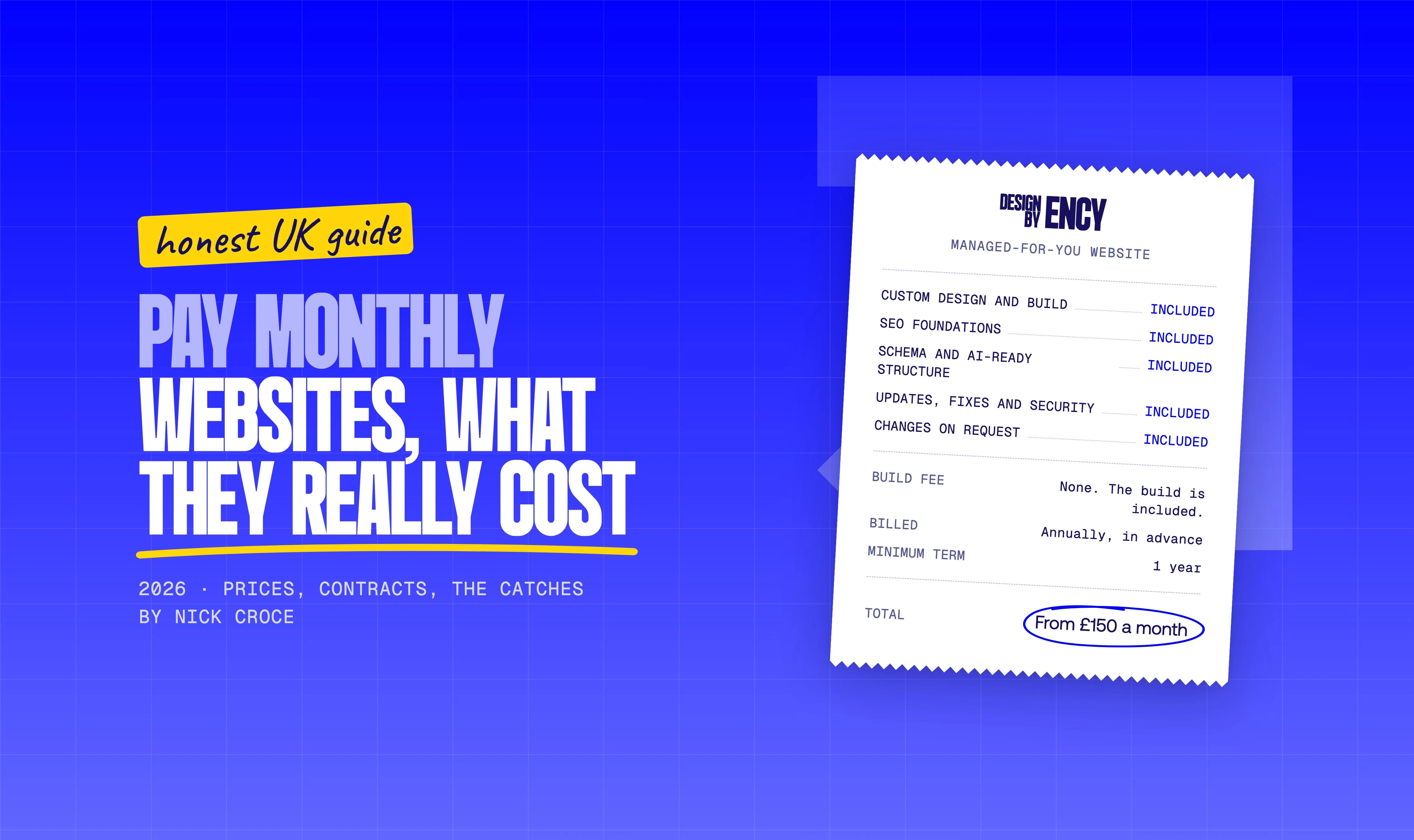
Since I’ve just told you what to ask every provider, here are my answers. Managed-For-You is from £150 a month with the build included and no separate build fee. That covers a custom-designed site (not a template), hosting, the domain and security, monthly updates to content, layout and visuals, bug fixes, and priority support when something’s urgent. The minimum term is one year, billed annually, so the year is paid up front, and you get the figure in writing before any work starts. And on question one: when you want to leave, I package up the full code and hand it over. It’s yours to host yourself, or to give to another designer.
It sits in the upper half of the price bands above, deliberately, because the fee buys a designer actually working on your site every month, not just hosting it. If what you want is a website you own outright and run yourself, that’s the custom Squarespace build instead, and I’ll tell you on the first call which one fits. The pricing page has both side by side.
Questions people ask
Are pay monthly websites worth it?
Yes, if the monthly fee buys real work and you’ve checked what you keep when you leave. No, if it’s hosting dressed up as a service. The three-year total and the ownership terms tell you which one you’re looking at.
Do you own a pay monthly website?
Usually not, on a subscription. On a spread-the-cost plan you own it once it’s paid off. Always ask, and get the answer in writing. With me, when you want to leave I package up the full code and hand it over, then it’s on you to host it yourself if you prefer.
Is it cheaper than paying for a website upfront?
In year one, almost always. Over three years it depends on the fee. Below about £80 a month a subscription usually works out cheaper than a custom build; above that you’re paying for ongoing service, which is only worth it if the service is good.
What happens if I stop paying?
On a subscription the site is taken offline, usually after the notice period. Your domain should still be yours if it was registered in your name, which is why that question is on the list above.
Can a pay monthly website be built on Squarespace?
It can, and some designers do it that way. Mine isn’t: Managed-For-You is a custom-coded build that I run for you. Squarespace is what I use when the client wants to own the site and manage it themselves.