Squarespace vs Shopify (2026): Which Is Better for a UK Shop?

By Nick Croce
I build websites on Squarespace for a living, and part of that job is telling people when their shop shouldn't be on it. Shopify is the one I send them to. So this isn't a "Squarespace wins everything" piece; it's the comparison I'd give a friend who asked which to use for a UK shop.
The short version: they're built for different businesses. Squarespace is a website platform with a good shop in it. Shopify is a shop platform with a website attached. Once you see it that way, most of the decision makes itself.
Prices below are from the UK pricing pages of both companies on 16 October 2026, and they will move. Check them before you sign up. I've compared Squarespace with Wix and with WordPress separately; this piece is about selling.
The short answer
Pick Squarespace if the shop is one part of a business whose website also has to do other things: win enquiries, take bookings, run a membership, publish, look designed. Tens to a few hundred products, one person or a small team looking after it, and design that matters as much as the cart. That's a florist, a studio, a consultancy with a few products, a coach selling downloads, a maker.
Pick Shopify if the shop is the business. Hundreds or thousands of products, stock in more than one place, wholesale as well as retail, selling through marketplaces and social channels, tills in physical shops, a warehouse or a fulfilment partner, international pricing. Shopify's whole platform is built around that, and the app store fills any gap you can name.
Price in the UK: the plans
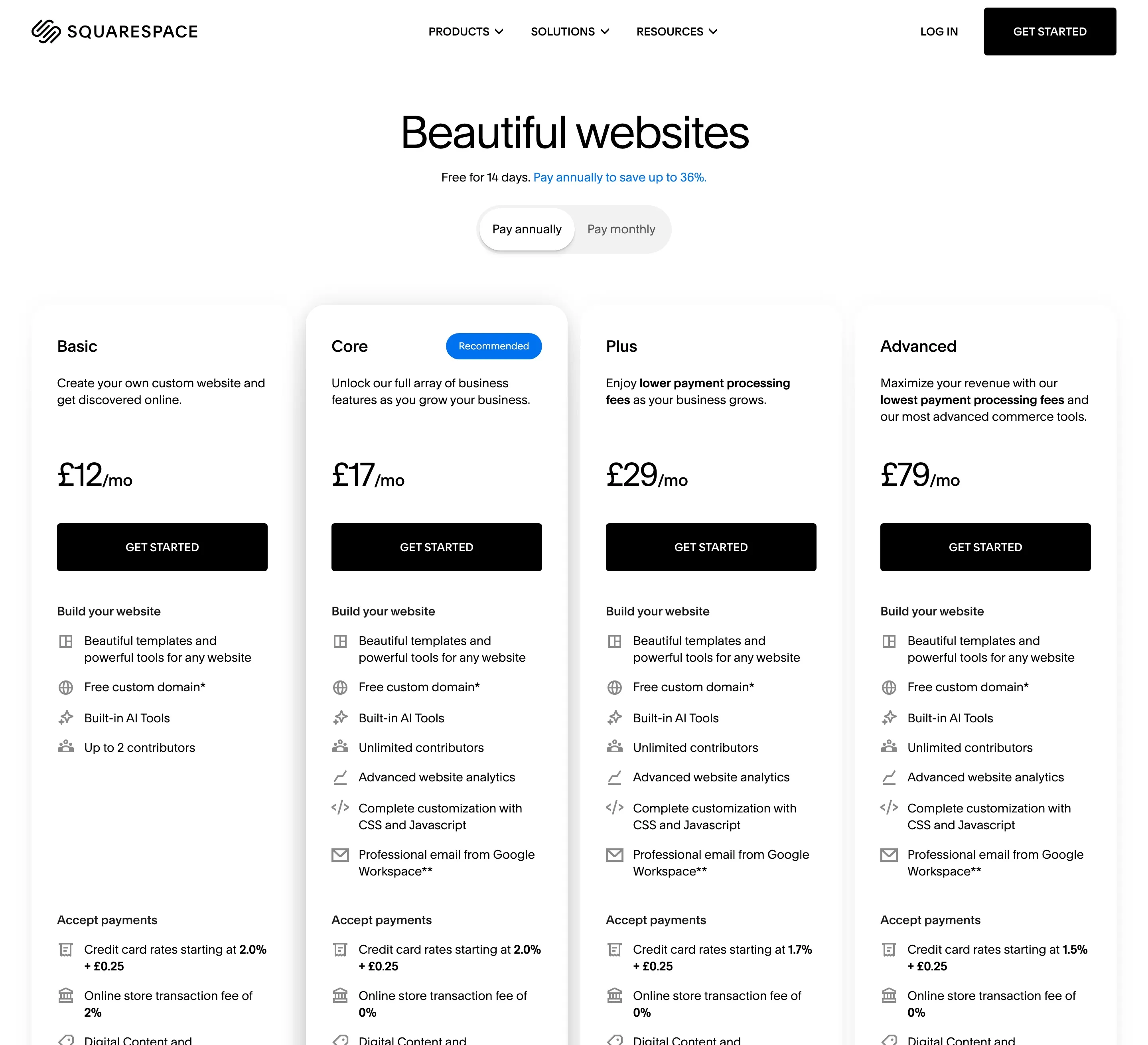
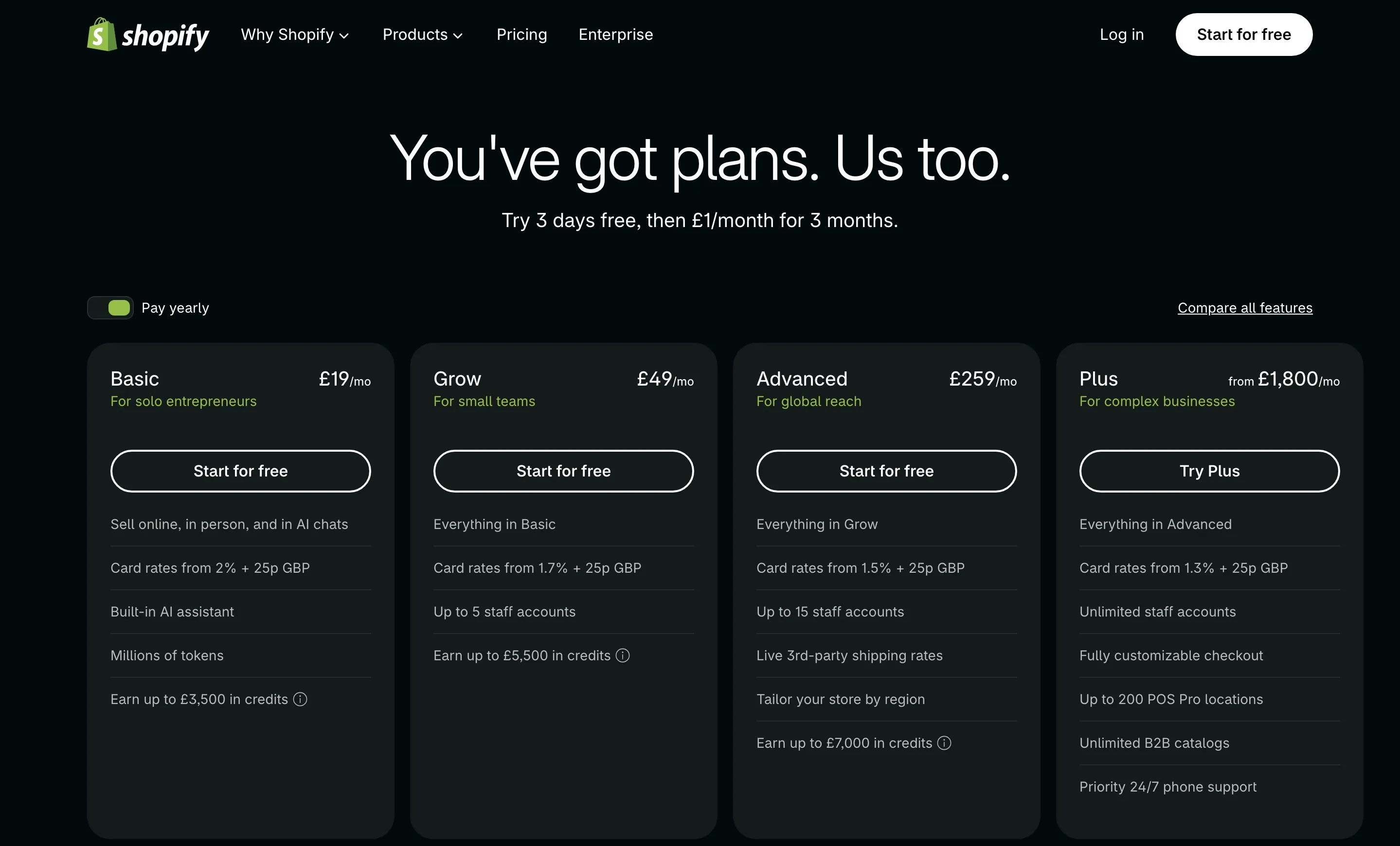
Both charge monthly and both are cheaper paid annually. Here's the UK line-up on annual billing.
| Squarespace, per month (annual) | Shopify, per month (annual) | |
|---|---|---|
| Entry | Basic, £12 | Basic, £19 |
| Mid | Core, £17 | Grow, £49 |
| Upper | Plus, £29 | Advanced, £259 |
| Top | Advanced, £79 | Plus, from £1,800 |
Paid monthly instead: Squarespace is £16, £24, £36 and £89; Shopify is £25, £65 and £344. Squarespace gives you 14 days free with no card. Shopify gives you 3 days free, then £1 a month for your first three months, which is a good offer if you want to build the shop properly before you pay full price.
One catch on the Squarespace side: the Basic plan charges a 2% transaction fee on online store sales, and the fee goes to 0% on Core and above. So a Squarespace shop realistically starts at Core, £17 a month. The fair entry comparison is Squarespace Core at £17 against Shopify Basic at £19. Two pounds apart, which is to say the plan price isn't the decision.
Card fees and transaction fees: where the real cost is
On a shop, the fees per order matter more than the plan, because they scale with your sales and the plan doesn't.
| Online card rate | Squarespace Payments | Shopify Payments |
|---|---|---|
| Entry plan | 2.0% + 25p (Basic) | 2% + 25p (Basic) |
| Mid plan | 2.0% + 25p (Core) | 1.7% + 25p (Grow) |
| Upper plan | 1.7% + 25p (Plus) | 1.5% + 25p (Advanced) |
| Top plan | 1.5% + 25p (Advanced) | 1.3% + 25p (Plus) |
| Using another card provider | No extra fee stated above Basic | 2%, 1%, 0.6% or 0.2% per order, by plan |
| Platform fee on sales | 2% on Basic, 0% above | None |
Work it through for a typical small shop: 200 orders a month at £25, so £5,000 of sales. On Squarespace Core that's £100 in percentage fees plus £50 in the 25p charges, £150, plus the £17 plan. On Shopify Basic it's the same £150 plus the £19 plan. A wash. The gap opens if you want the lower rates: Shopify's 1.7% needs Grow at £49, Squarespace's 1.7% needs Plus at £29.
The line to watch is Shopify's extra fee for not using Shopify Payments. If you've got reasons to keep your existing card provider, that's 2% on top of their rates on the Basic plan, which is the same penalty Squarespace charges on its own Basic plan. Both companies want you on their payments product, and both price it that way.
The editor and design: this is the real difference
A Squarespace shop is built in the same editor as the rest of the site. Product pages, the shop grid, the cart and the checkout follow the same fonts, colours and spacing as your homepage, and you change them in one place. If you care that the shop looks like it belongs to the brand rather than to the platform, this is Squarespace's strongest card, and it's why the florists, makers and studios I build for stay on it.

Shopify is theme-based. You pick a theme, you customise it in the theme editor, and anything the theme didn't anticipate is a developer job in Shopify's own template language. Shopify sites can look extraordinary, but the ones that do had a developer, not just a theme. The flip side is that Shopify's checkout is the best in the business. Shopify's own claim is that its checkout with Shop Pay converts up to 50% higher than a guest checkout, and even allowing for the fact that it's their number, the experience of paying on a Shopify store on a phone is noticeably slicker than almost anywhere else.
Squarespace's checkout is on your domain, styled with your site, and it works well. What you can't do is redesign it. For a shop doing a few hundred orders a month that's fine. For one doing a few thousand, the checkout is where the money is, and that's Shopify's home ground.
Products, shipping and the selling features
Squarespace covers more than people expect. Physical products, digital downloads, services, subscriptions billed monthly or every two weeks, courses and memberships, gift cards. Shipping by flat rate, by weight or by real-time carrier rates, tools to calculate sales tax, inventory, discount codes, product reviews, and a point-of-sale app on iOS for selling in person where it's available. For most UK small shops that's the full list of what they'll ever use.
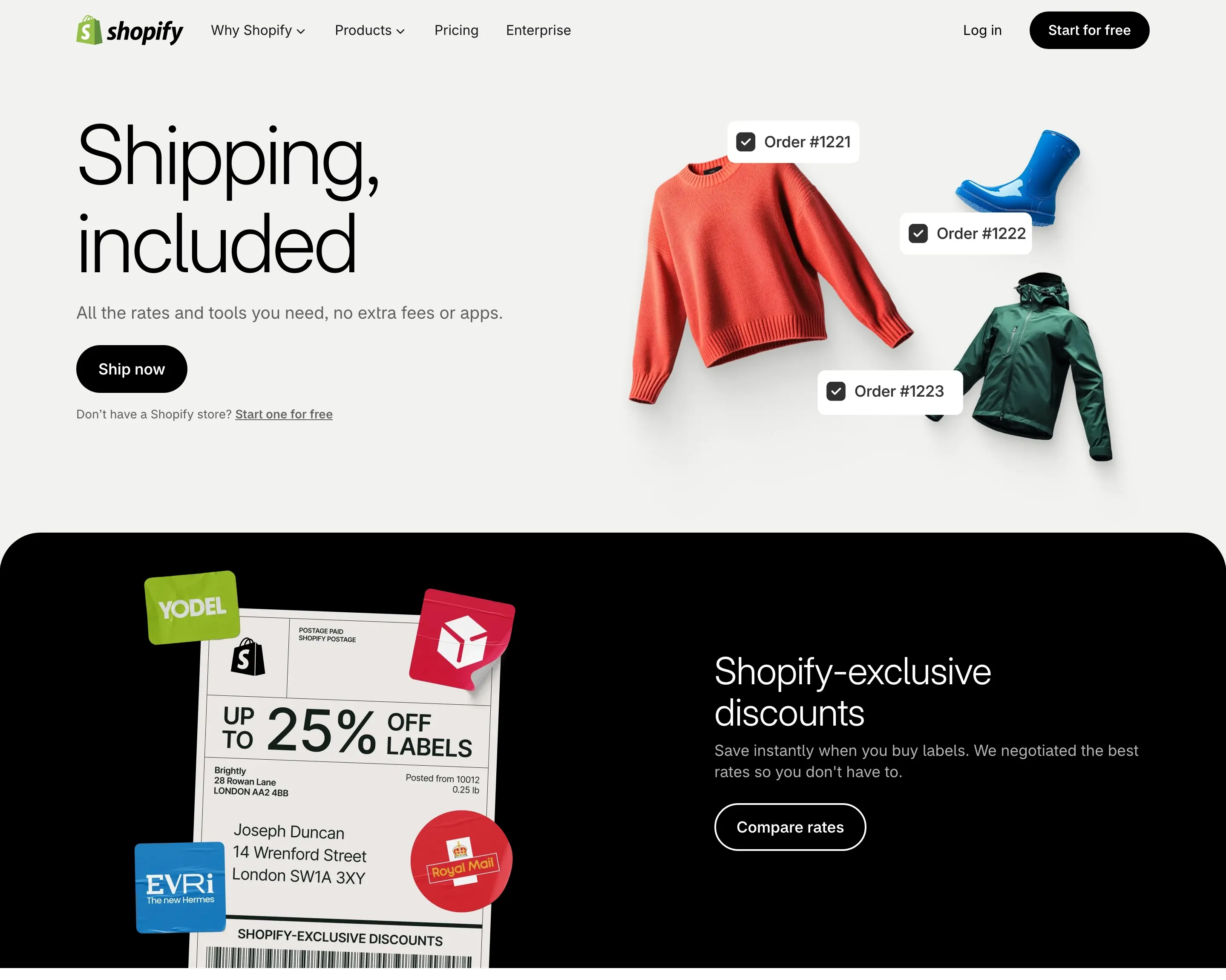
Shopify has all of that and then keeps going. Stock across multiple locations, staff accounts (up to 5 on Grow, 15 on Advanced, unlimited on Plus), live third-party shipping rates on Advanced, storefronts tailored by region, B2B catalogues and up to 200 point-of-sale locations on Plus, and a checkout you can fully customise at the top end. None of that is for a florist. All of it is for a business that's become a retailer.
Apps and integrations
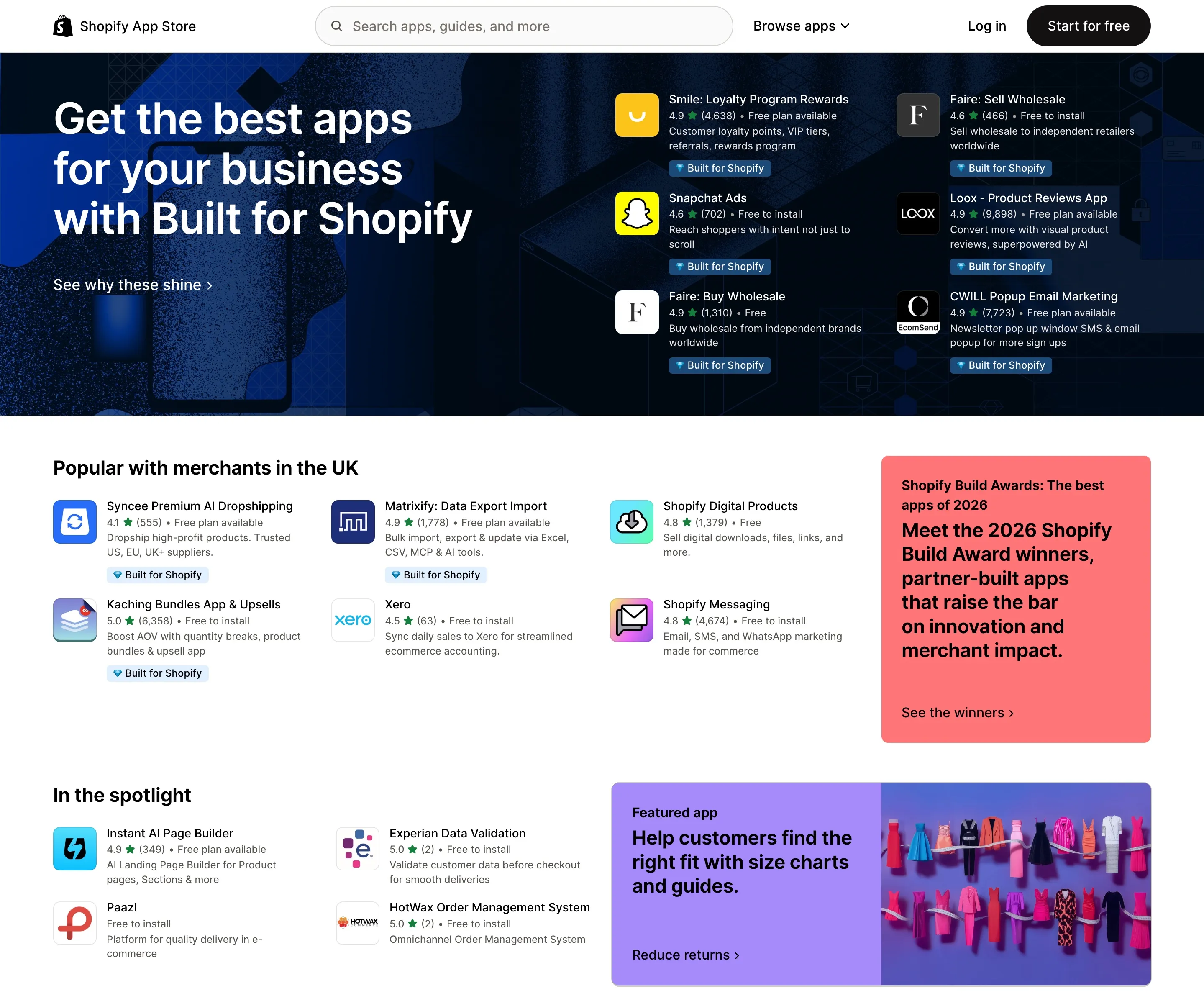
Shopify's app store has more than 21,000 apps. If there's a thing you want a shop to do, someone has built it. The cost of that is that a real Shopify store tends to run ten or fifteen apps, each with a monthly fee, each adding a little weight to the page and a little complexity to the business. Budget for apps as a line item, not an afterthought.
Squarespace builds the common things in and offers a smaller set of extensions and embeds for the rest. Fewer one-click options, but also fewer bills and a simpler site to look after. In practice I've rarely hit a thing a Squarespace shop client needed that couldn't be done; I have often seen Shopify stores paying £100 a month in apps they'd forgotten they had.
SEO and content
Both platforms can rank. Both give you editable titles and descriptions, clean URLs, sitemaps, redirects and alt text. The difference is what the rest of the site is like.
Squarespace is a content platform, so the blog, the about pages, the case studies and the service pages that bring people in through Google are first-class citizens, and they share the shop's design. Shopify's blog and pages are an afterthought by comparison, and its URL structure is fixed: every product lives under /products/ and every category under /collections/, whether you like it or not. If your plan for getting customers is content, Squarespace makes that easier. If your plan is ads and marketplaces, Shopify doesn't care, and neither should you. I've written up the Squarespace SEO checklist I run on every site if you want the detail.
Who should pick Shopify
- The shop is the business, and the website exists to serve it.
- Hundreds or thousands of products, or stock in more than one location.
- You sell wholesale as well as retail, or in physical shops as well as online.
- You sell through Amazon, eBay, TikTok Shop or Instagram as well as your own site.
- You need a specific app, a fulfilment integration or a customised checkout.
- You expect to grow to the point where the fees matter more than the design.
Who should pick Squarespace
- The shop is one part of a wider business that also needs to win enquiries, take bookings or publish.
- A catalogue in the tens or low hundreds, looked after by one person.
- Design matters as much as the cart, and you want the shop to look like the rest of the site.
- You sell services, subscriptions, courses or digital downloads alongside, or instead of, physical products.
- You want one monthly bill and no app budget.
- You might hire a designer. Most UK Squarespace specialists build shops on it; my own custom builds add a shop from £1,000 on top of the site.
A Squarespace shop that works: Arta's Flowers
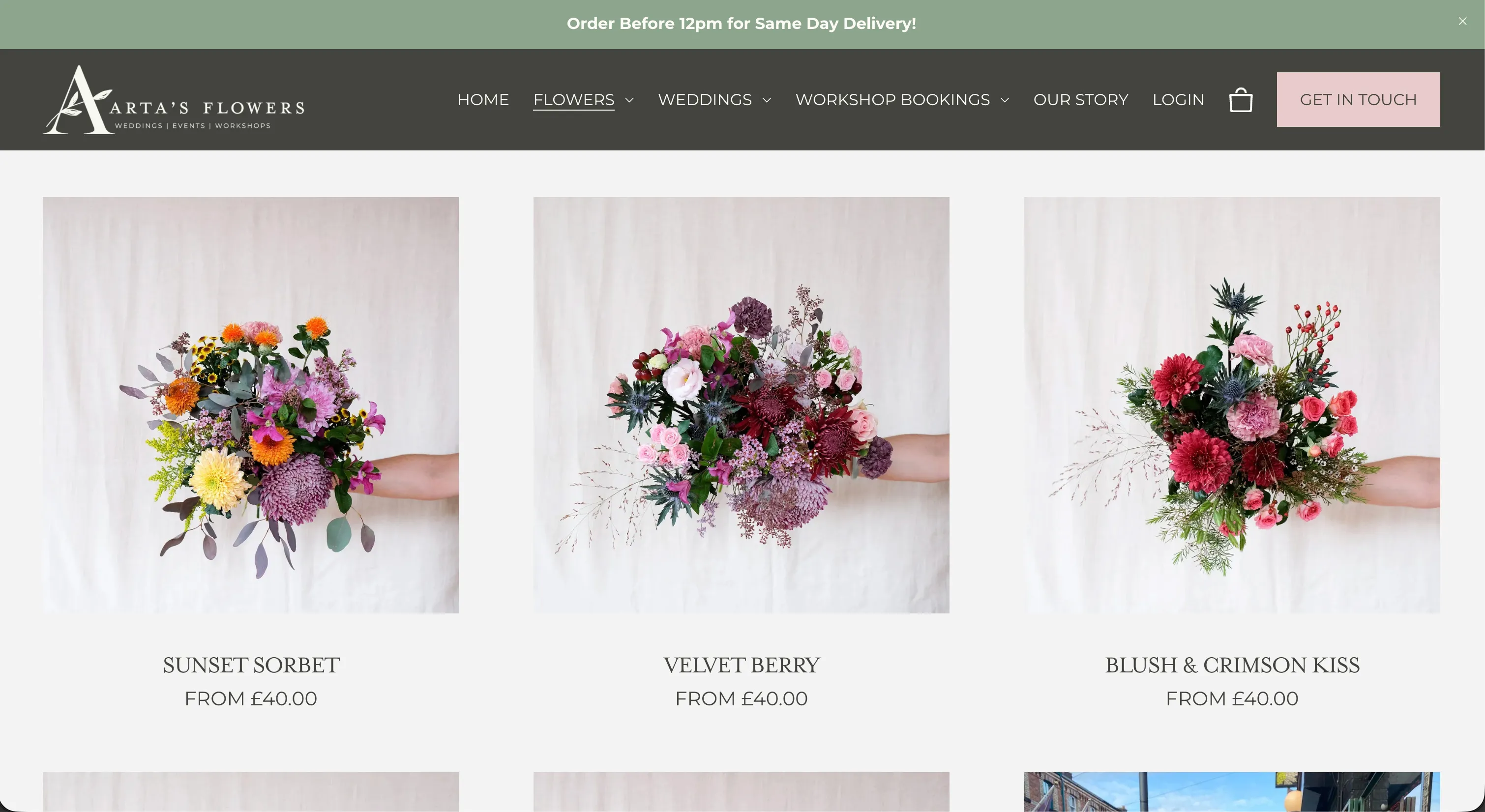
Arta's Flowers in Liverpool had outgrown a DIY Squarespace shop. The catalogue was good; the navigation wasn't, and customers kept choosing the cheapest delivery option even when they lived miles away, leaving Arta to cover the difference. We rebuilt the site, cleaned up the checkout, added workshop bookings and subscriptions, and set up local delivery so the right option is selected automatically from the customer's postcode. Online orders went up by half. That's a shop that belongs on Squarespace: a few dozen products, a strong brand, a business that's also a workshop venue and a florist for events. Digital products are built in too, so a coach selling downloadable programmes or a studio selling course access gets the same shop with nothing bolted on.
Moving between them
Both platforms export products as a spreadsheet and both import one, so the catalogue itself is a morning's work either way. The job is everything around it: the design, which doesn't carry across in either direction, and the URLs. Shopify's /products/ and /collections/ structure is different from Squarespace's, so every product and category page needs a redirect to its new address or you lose the rankings you've built. That's the same discipline as any redesign, and my website redesign checklist covers the redirect map in detail.
Questions people ask
Is Squarespace cheaper than Shopify in the UK?
For a small shop, barely. Squarespace Core at £17 a month against Shopify Basic at £19, with the same 2% + 25p card rate on each. Shopify's upper plans cost far more than Squarespace's, but they also do far more. The real difference in cost is apps: a Shopify store usually needs some, a Squarespace shop usually doesn't.
Can Squarespace handle a large online store?
It can handle hundreds of products comfortably. Once you're into thousands of products, multiple stock locations, wholesale pricing or a fulfilment partner, you've outgrown it, and Shopify is the right move.
Does Squarespace charge transaction fees on shop sales?
Only on the Basic plan, where it's 2% of each online store sale. Core, Plus and Advanced charge 0%, so a shop should be on Core or above. Card processing fees apply on every plan, as they do everywhere.
Is Shopify better for SEO than Squarespace?
Neither is better in a way that will decide your rankings. Squarespace is better for the content side of SEO, because its pages and blog are stronger and share the shop's design. Shopify's fixed URL structure is a mild annoyance, not a penalty.
Can I move my Shopify store to Squarespace, or the other way?
Yes. Export the products, import them, rebuild the design, and redirect every old URL to its new one. The redirects are the part that gets skipped and the part that costs you traffic when it is.
Do I need a designer for either?
No for a simple shop; both platforms are built so you don't. Yes if the shop needs to look like a brand rather than a template, or if you're moving and want to keep your Google rankings. How to choose a Squarespace designer covers what to look for.
Not sure which way to go? Book a free 15-minute call. If Shopify is the right answer for you, I'll say so, and point you at someone who builds on it.