Law Firm Website Design UK (2026): What Clients Check, What the SRA Requires, and What It Costs

By Nick Croce
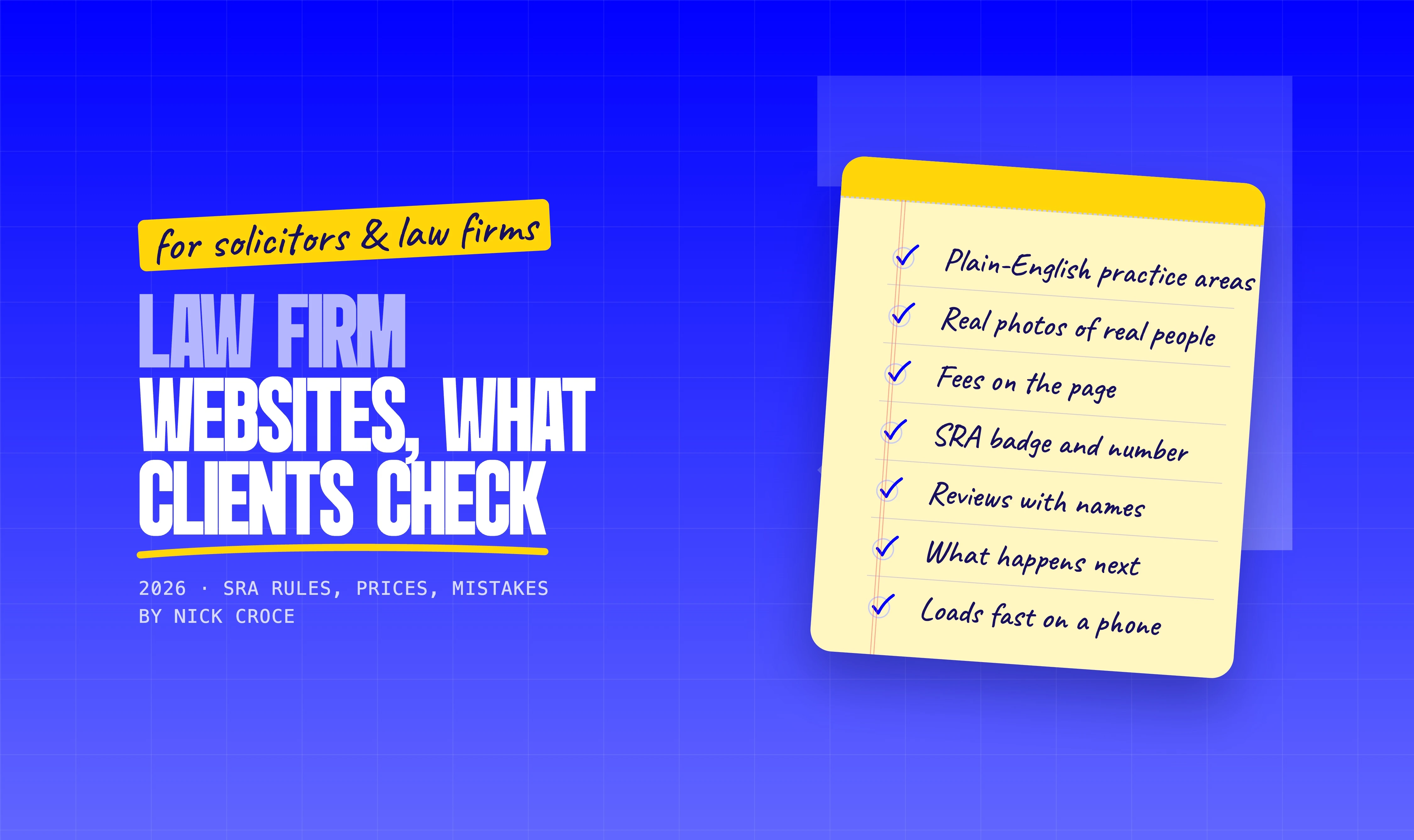
Nobody picks a solicitor on a whim. By the time someone lands on a law firm’s website they’ve usually got a problem they didn’t want, a deadline they didn’t choose, and three other tabs open with your competitors in them. The website’s job is to make that person confident enough to pick up the phone. Most law firm websites make them click away instead: a navy header, a stock photo of a handshake, a wall of practice areas written for other lawyers, and a phone number buried on a contact page.
I’ve built sites for two legal clients, a business law firm in San Francisco and a London investigations practice that works alongside lawyers, plus a long list of clinics, consultancies and charities that sell the same thing a law firm does: trust, before anyone has met you. This is what a law firm website has to do in 2026, what the SRA says it must include, what one costs in the UK, and the mistakes I see on almost every firm’s site. Prices were checked on 12 November 2026.
What a law firm website is actually for
A tradesperson’s website has to win a phone call in ninety seconds. A law firm’s has to survive twenty minutes of scrutiny. The person reading it is anxious, comparing, and looking for a reason to rule you out. Every page is either building confidence or spending it.
Google’s own AI summary for “law firm website design” lists what that confidence is built from: practice area pages that answer the client’s questions rather than recite the law, solicitor profiles with real credentials and a direct way to contact them, visible proof, a fees page, and a site that works on a phone. That matches what I see in the firms that get enquiries from their site. None of it is about looking expensive. It’s about being clear.
What a prospective client checks before they call
- Do you do my thing? Practice areas named the way a client would say them: “I’m being made redundant”, “we’re buying a house”, “my business partner wants out”. One page each, in plain English, with what happens first and roughly what it costs.
- Who will I actually be dealing with? Profiles with a real photograph, what the person specialises in, how long they’ve done it, and an email or direct line. “Our team of experienced professionals” is not a profile.
- What will it cost me? A fees page that says something. Even “initial consultation £150, fixed fees for conveyancing and wills, hourly rates from £X for everything else” beats silence. For some services the SRA requires it anyway, which is the next section.
- Has this worked for people like me? Google reviews pulled onto the site with names, review platforms you’re on, Legal 500 or Chambers rankings if you have them, and anonymised examples of matters you’ve handled.
- Are you legitimate? Your SRA number and the SRA digital badge, Lexcel or other accreditations, Law Society panel memberships, your registered office. These are the things a nervous person looks for and a scammer can’t fake.
- How do I start? A phone number that works with one tap, a short enquiry form, and a line that says what happens after they send it. The firms that say “we’ll call you back within one working day” get more forms than the ones that don’t.

What the SRA says your website must include
If the firm is regulated by the Solicitors Regulation Authority, parts of the website aren’t optional. The SRA Transparency Rules require firms to publish price and service information on their website for certain services offered to the public and to businesses. For individuals that covers residential conveyancing, probate where the estate is uncontested and in the UK, immigration applications (excluding asylum), representation at the First-tier Tribunal in immigration cases, motoring offences dealt with in a single hearing, and bringing unfair or wrongful dismissal claims at the Employment Tribunal. For businesses it covers defending those employment claims, debt recovery up to £100,000, and licensing applications for business premises.
The costs information has to include the total cost of the service or, where that’s not practicable, the average cost or a range, along with what the price covers. The rules also require the website to carry the firm’s complaints handling procedure, including how and when a complaint can be made to the Legal Ombudsman and to the SRA, and to display the firm’s SRA number and the SRA digital badge. This is a summary, not legal advice: the rules are on the SRA’s site and your compliance officer will know which of your services fall under them. Firms in Scotland and Northern Ireland are regulated separately.
The design point is this: a lot of firms treat the transparency pages as a box to tick and bury them. Put them where clients can find them. The fees page the regulator made you write is the page your prospective client most wants to read.
What makes a law firm website feel credible
Restraint, mostly. The firms that look most established online are the ones that do the least: one or two typefaces, generous white space, photography of the actual office and the actual people, navigation that reads like a table of contents rather than a menu of everything. No sliders, no animated counters, no “welcome to our website”. A site that loads in a second on a phone says more about how the firm runs than any paragraph about client care.
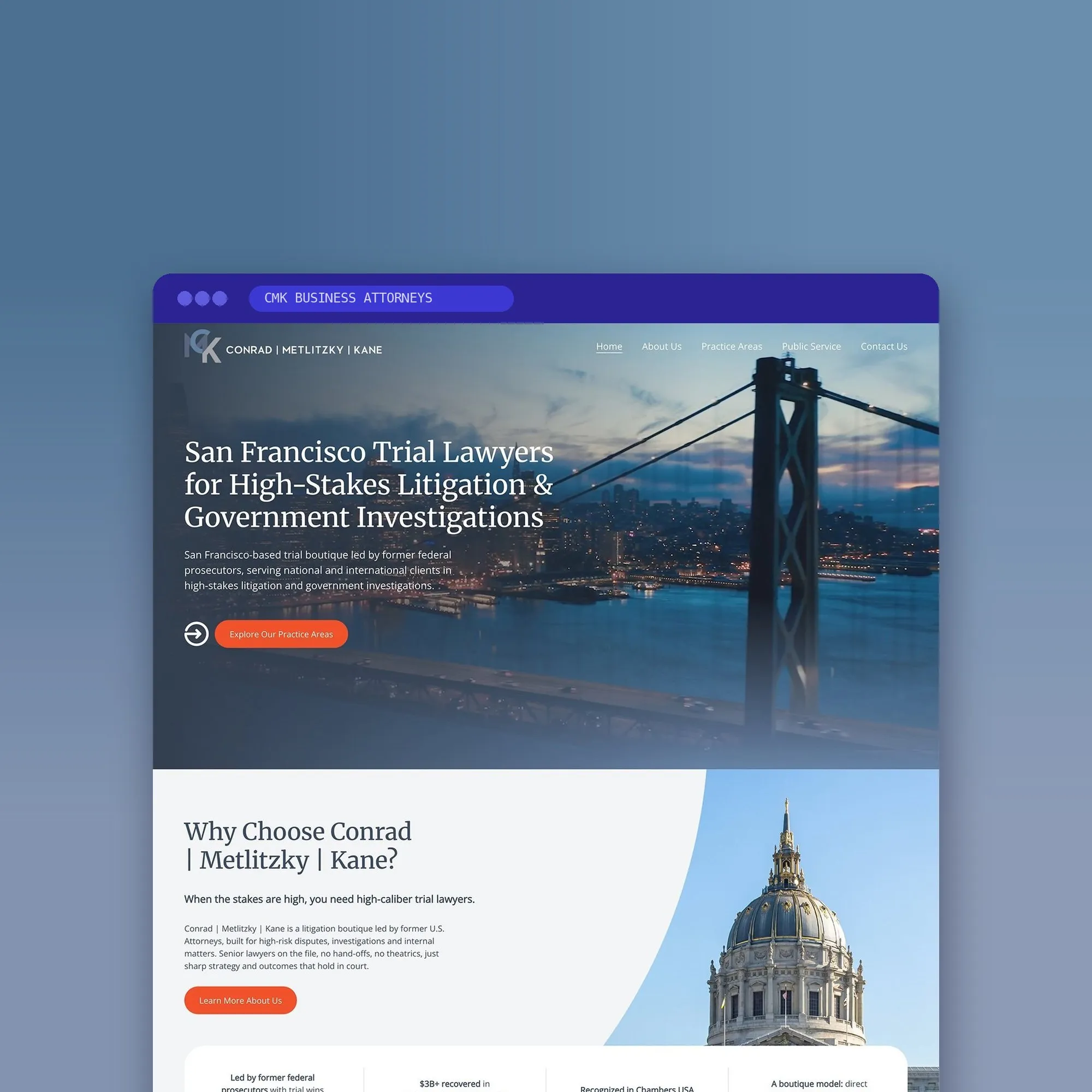
When Conrad Metlitzky Kane, a business law firm in San Francisco, came to me their site was an ageing Squarespace 7.0 build that no longer reflected the firm’s standing. Six weeks later it was a clean 7.1 rebuild: clear structure, obvious practice areas, confident typography and nothing on the page that didn’t need to be there. The brief was credibility first, and the design got out of the way of it.
Crystal Vantage, a London practice specialising in high-stakes investigations and legal solutions, needed something a general template couldn’t give them: a home for the downloadable briefings they publish for clients, plus an easy way to schedule a consultation. The site I built gives the briefings their own section, keeps the navigation simple, and makes booking a conversation the obvious next step. Eight weeks, built in Squarespace.

What a law firm website costs in the UK in 2026
The honest answer depends on whether you want to own and run the site or have someone run it for you. These are my own prices and the UK brackets I see in quotes clients forward me.
| Route | Cost | Who runs it | Best for |
|---|---|---|---|
| Build it yourself on Squarespace | £12 to £29 a month, plus your evenings | You | A sole practitioner with one service and time to spare |
| One-off build from a designer | My builds from £3,000 (four pages), £5,000 (eight pages, custom code), £8,500 (no limits). UK agencies typically £5,000 to £15,000 | You, after handover training | Firms with someone in the office who’ll look after it |
| Managed-For-You, pay monthly | From £150 a month, billed annually, build included | Me, every month | Firms with no web team who want it handled |
Most law firms I speak to are in the last row. Nobody in a six-partner practice wants to log into a website, and the alternative is paying an agency an hourly rate to change a fee or add a new solicitor. The Managed-For-You plan was built for exactly that firm: custom site, then every change, fix and update handled for one fee, with the full code handed over if you ever leave. If you’d rather own it outright and run it in-house, a custom Squarespace build is the right answer and I’ll quote one on the first call.
The wider market is in the three ways to get a small business website, and the Squarespace platform fees are broken down in the cost guide.

The mistakes I see on law firm websites every week
- A stock photo of a gavel, the scales of justice or a handshake. UK courts don’t even use gavels. Photograph your own office.
- Practice areas written in the language of the profession. “Contentious probate” is a page title for a client who typed “contesting a will”.
- No fees anywhere. The transparency pages hidden under “Legal” in the footer in grey text.
- The partners’ profiles with no photographs, or photographs from 2011.
- A slider. Nobody waits for slide three.
- The phone number as text, not a button. On a phone, it should be tappable on every page.
- “Contact us” with no indication of what happens next, how quickly, or whether the first conversation costs anything.
- A site last updated when the newest partner joined. The copyright year, the team page and the news section all give it away, and clients notice.
Questions people ask
How much does a law firm website cost in the UK?
In 2026, anywhere from £12 a month doing it yourself on Squarespace, to £3,000 to £8,500 for a custom build from an independent designer like me, and £5,000 to £15,000 from a UK agency (more in London). A managed, pay monthly site with the build included is from £150 a month on my plan, billed as a year up front. Firms with a large number of practice areas, multiple offices or a client portal will sit at the top of those ranges.
What must a solicitor’s website include under the SRA Transparency Rules?
For SRA-regulated firms offering the listed services (residential conveyancing, uncontested probate, immigration applications, certain employment tribunal claims, motoring offences in a single hearing, debt recovery up to £100,000 and licensing applications), the website must publish price and service information, including the total cost or an average or range. It must also carry the firm’s complaints procedure with details for the Legal Ombudsman and the SRA, the firm’s SRA number and the SRA digital badge. Check the current rules on the SRA’s website, as this is a summary rather than advice.
Can a law firm website be built on Squarespace?
Yes, and both of the legal sites in my portfolio are. Squarespace handles the practice area pages, team profiles, fees pages, downloadable briefings and consultation booking a firm needs, and a solicitor can update their own profile without calling a developer. Where it struggles is client portals and case management integration, which is a custom build instead.
How long does a law firm website take to build?
The two legal sites I’ve built took six and eight weeks. The design is rarely the slow part. Getting profile photographs, fees and practice area copy signed off by the partners is, so start those before the design does.
Should a law firm have a blog?
Only if someone will write it. A news page with three posts from 2022 does more harm than no news page. If a partner will write one plain-English guide a month on the questions clients ask (“what happens at a first conveyancing appointment”), it’s the best SEO a firm can do. If not, put the energy into the practice area pages instead.